Insights into the life and craft of the inaugural recipient of the 1905 Legacy Award in the Visual Arts
By Meagan Atiyeh, Visual Arts Program Senior Advisor
The story of Lillian Pitt as a professional artist begins when she, as a young hairdresser whose back pain wouldn’t allow her to continue that work, finds art classes at community college. What follows is not merely a change of vocation. Clay, as a medium, becomes her way to think about the body, about time and about the persistence of Indigenous presence along the “Big River,” Nch’i-Wana. [1]
Born on the Warm Springs Reservation and tribally affiliated with Warm Springs, Wasco and Yakama peoples, Pitt came of age amid the economic, social and psychological conditions of midcentury Oregon, when Indigenous life was routinely marginalized. She describes her youth without sentimentality, recalling poverty and prejudice alongside a stubborn appetite for learning. [2] That insistence on possibility, on making a life from what is at hand, threads through her biography as distinctly as the repeated almond eye, long nose, and small O-shaped mouth that recur in her sculptural faces.
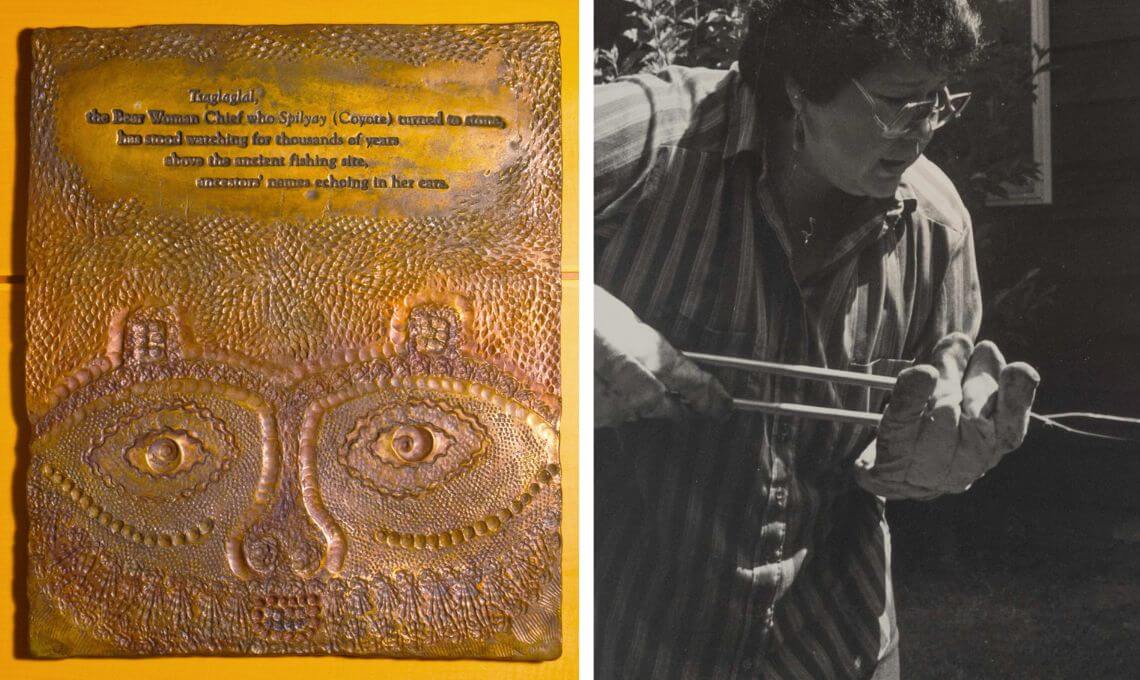
Central to Pitt’s iconography is Tsagaglalal (“She Who Watches”), a petroglyph figure located near the once-thundering Celilo Falls, a site of trade, ceremony and intertribal gathering until damming flooded the area and reshaped both river and life. Pitt’s interpretation of “She Who Watches” is among her most recognizable images, a contemporary reanimation that insists on continuity rather than nostalgia.
According to Pitt, “I was visiting with [Lucinda Smith] and she says ‘well, you know, your daddy was born in Tenino, but Tenino isn’t really Tenino, that’s just the name of that place; it’s a name of an Indian group, and they lived on the mouth of the Deschutes River, and his mother’s Indian name was [Wah-yuten] and her sister’s name was [Tim-ex] and they were born under the gaze of [Tsagaglalal].’ … So then I was able to go up, and when I first saw her it was such a transformative emotion, and it gave me such a tremendous sense of power of self, that no one can ever take away. Not power like the politicians, but just this wonderful sense of being.” [3]
Lillian Pitt’s Voices is a series of 26 bronze relief plaques located in the Oregon Convention Center. Each represents the voices of Native people throughout the region. Lillian felt it was her obligation to honor all of the Native peoples of the region in her work.
“My goal wasn’t just to produce public art but to educate viewers about the rich cultures and history of the various Native peoples who lived throughout Oregon,” she said, “We titled the work Voices because we thought of the plaques as giving our ancestors a voice … giving them an opportunity to be heard in this modern world where the memory of them is otherwise being drowned by progress.” [4]
If traditional imagery gives Pitt’s work its form, her openness to technique gives it range. She has moved across media with a restlessness that reads less like stylistic experimentation than like an ethic: no single material can hold a river’s worth of story. Instead, she has born clay masks, cast glass figures, bronzes, jewelry and prints. Her practice is often described through its materials, but its deeper medium is relation: to place, to lineage and to the artists and communities she continually gathers into her practice.
Pitt’s public commissions show her collaborative way of making room. “We each share our strengths,” she writes, describing a long-term Trimet project for which she served as team leader alongside other Native artists, pairing large-scale sculptural elements with community workshops. [5] This is not leadership as branding; it is leadership as structure, an attention to process that treats community engagement as part of what the work is. “Collaborating with others is how these magical things happen,” she said. [6] Her work now adorns important civic spaces — from the Convention Center to Portland State University, stretching out along the Interstate MAX line, and upcoming at the Portland International Airport.
“I am self or Community taught. My artist friends have taught me printmaking, glass making, bronze making. They have invited me to Japan, New Zealand, Australia, Europe, Canada to workshops, lectures and exhibitions. We love sharing our works and talking about our histories.” [7]
That same ethic shows up in the quieter economies of mentorship. Multiple accounts describe Pitt teaching workshops and giving guidance to younger artists, as a way to help them “carve their own paths.” [8] In a media landscape that often romanticizes the solitary maker, Pitt’s biography offers a different model: the artist as steward — of stories and also of people.
Her template for this generosity, she has said, came through mentorship received. Pitt recounts a formative exchange with R.C. Gorman, who challenged her with practical questions: what do you make, do you sell it, what is it worth? And then, more importantly, he purchased work and used his network to open doors. Pitt recalls deciding then that if she ever gained recognition, she would meet others with the same grace and material support — an intergenerational practice of access. [9]
Pitt teaches that traditional art is not motif; it is responsibility. And she models a kind of authority that is never only personal. It is shaped by many hands, carried forward, still creating. Her achievement is not simply that she has made powerful objects, but that she has insisted on an art world ample enough to hold Indigenous time — not as distant preface, but as ongoing present.
“My purpose in my life and artworks is to let everyone know we are still here working, fishing, and making art, baskets, and tools.” [10]
“Her aesthetic rooted in the land and waters of the Columbia River reflects on the brilliance of the cultures she experienced in childhood and led her to greater circles of international artistic communities of Indigenous peoples of the Pacific Rim,” says Elizabeth Woody, poet, Director of the Museum at Warm Springs, and also Pitt’s niece. “Her elders named her after the root Waq’amu, and she staunchly holds onto the ground and does not let go like the cherished living root of our earth’s vitality. She held ground and broke ground in major art institutions and academic venues that had not previously shown contemporary works from thriving Indigenous artists of her generation.”
References
[1] “Lillian Pitt: My Ancestors Are Tough People,” Confluence Project, November 3, 2020. (Confluence Project)
[2] Tina Lassen, “Meet Warm Springs Artist Lillian Pitt,” Travel Oregon, December 14, 2016 (updated March 1, 2018).
[3] Confluence Project, “Lillian Pitt: My Ancestors Are Tough People”
[4] “Lillian Pitt Public Artwork: ‘Voices,’ at the Oregon Convention Center (U.S. National Park Service).” National Parks Service. Accessed January 29, 2026. https://www.nps.gov/places/lillian-pitt-public-artwork-voices.htm.
[5] Lillian Pitt, “About the Artist,” in “The Art of Lillian Pitt: Past and Present,” Salem Art Association, September 1-October 29, 2023.
[6] Lassen, “Meet Warm Springs Artist Lillian Pitt.”
[7] Pitt, “About the Artist.”
[8] Lassen, “Meet Warm Springs Artist Lillian Pitt.”
[9] Randi Bjornstad, “Native American artist Lillian Pitt recreates and honors her ancestry through her art,” Eugene Scene, October 18, 2019.
[10] Pitt, “About the Artist.”
Words from a Mentee
The 1905 Legacy Award in Visual Arts is selected through a confidential nomination and review process led by an anonymous panel of arts professionals, so recipients have no idea they are being considered. This year, Lillian learned of the honor in a way that reflects the spirit of her own generosity. Her mentee, 2025 Hallie Ford Fellow Sara Siestreem (Hanis Coos), invited her to breakfast with Visual Arts Program Senior Advisor Meagan Atiyeh. When they arrived, Foundation President Kara Carlisle was there to share the surprise. Here is Sara’s reflection on her mentor:
“Once you know what you are looking at, you will find her in all sectors of the city and beyond. No matter where you go, she will be with you. In her studio, she works with many (any) medium and dimensions. She is one of those real artist people, total confidence and mirth, in joy and at ease with her imagination and physical being, both in and out of the studio. She makes it all look easy, but I can tell you that it is not. That is just how good she is.
As if all of that was not enough, because it is who she is (and our culture) she has always made sure to keep us, the next generation coming along (in every way imaginable). How many people has she taught to use clay, make prints, collaborate, work in glass, sit on committees, talk to governments, negotiate business deals, work through ceremony, tell a story, where to get the best Salmon Sandwich in the gorge, give a gift, receive a gift, look for wild onions, protect privacy, honor the ancestors, work with other people, not burn bridges, tell a joke, call out evil publicly, fight for women? I could go on.
Formally, I have had the immense gift of being one of her mentees for a quarter century, half my life. She has stood by me and my work since the day we met, ensuring I got the light and love I needed, both from her and in the world. She opened every door and demanded I walk through them, then came with me to make sure I was ok. I can tell you with all confidence, I would not be here without her. It gives me great pride, joy, and relief that we share recognition from The Ford Family Foundation. I find her nomination as a 1905 Legacy Awardee monumentally poetic and percussive.”