Douglas County native Samantha Herron to support K-12 pathways work for the Children, Youth and Families team.
The Ford Family Foundation is delighted to welcome Douglas County native Samantha Herron as the new program officer for the Children, Youth and Families team. Samantha holds years of experience as an award-winning rural teacher, with a keen focus on developing innovative classroom engagement practices and education-to-workforce pathways.
We met with Samantha to learn a little more about her journey to the Foundation.
Tell us about your background and where your journey has taken you.
I was born and raised primarily in Tenmile, OR, in a single parent household. My mom worked for Roseburg Forest Products, where she tended the dryer at the mill for 40 years. I graduated from Douglas High School in 2005 and went to Umpqua Community College. I transferred, then graduated with a bachelor’s degree in history from Southern Oregon University. After a foray into a variety of jobs (Peace at Home, local restaurants, a mixed-needs preschool) I went back to Southern Oregon for my master’s in teaching, finishing up in 2016. I did my student teaching at South Umpqua High School and North Middle School in Grants Pass and ultimately started my public-school career in Coquille. I’ve been teaching junior high social studies there, as well as a variety of other extra-curricular activities, for the last 10 years.
Did you always know you wanted to be a teacher?
You know, I really had no interest in going to college, even though I was in the top of my high school class. I came from poverty, and no one in my family understood college or what it meant to go there. Though they all encouraged me to go—no one knew what that entailed. Also, as is common in small towns, I had little to no exposure to careers other than what my mom and extended family were doing (which was on the lower end of the socioeconomic spectrum). My high school lost its college readiness counselor due to budget constraints, so there was no one to guide students like me. I was a bright, very active student with no prospects. Even still, one of my teachers saw potential for me to thrive in a post-secondary environment and submitted an application for the now-retired Ford Jumpstart Award. Because of that award I was convinced to give higher education a try. That, along with the Ford Sons and Daughters scholarship award through my mom’s employment at RFP, got me through UCC. From there, I fell in love with school and transferred to a four-year university.
At the Foundation, we love when teachers get the recognition they so deeply deserve. Can you tell us about the awards you received?
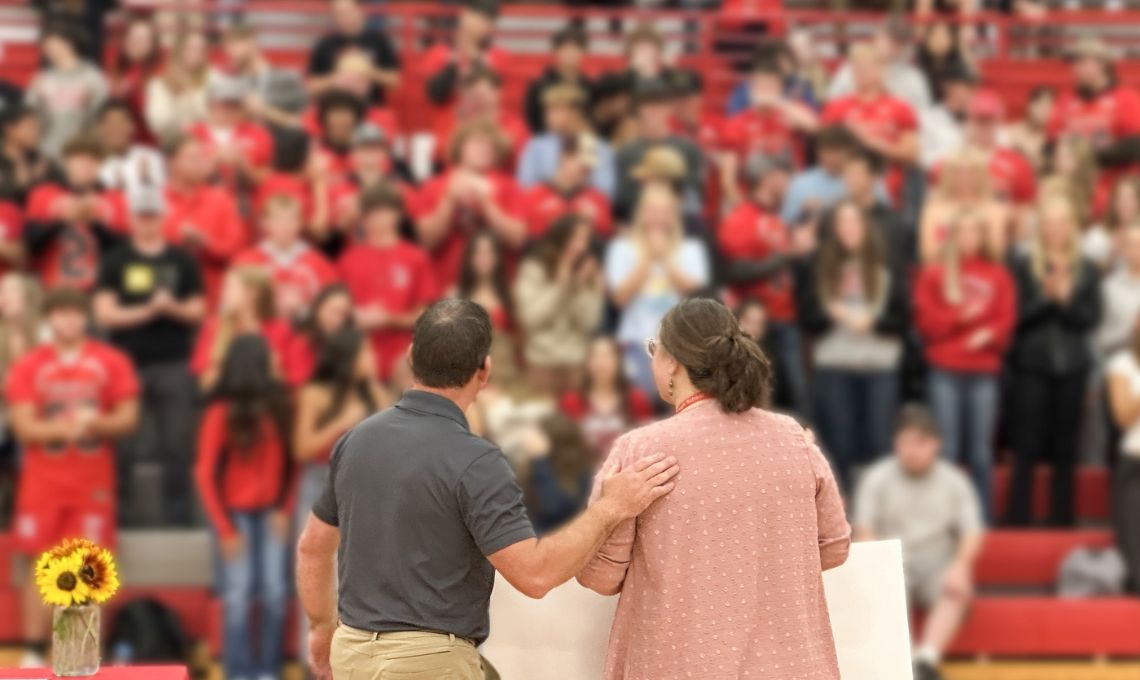
I was nominated for Oregon’s History Teacher of the Year in 2021, right off the back of COVID, and then, in 2024, received Oregon’s Teacher of the Year, the regional award, which meant I was nominated while I was pregnant and teaching. My 4-month-old was at the surprise awards ceremony (which was held while I was on maternity leave). It made the experience even more meaningful. You’re right though—teachers don’t have a lot of opportunity for formal recognition, but I do believe most people continue to teach because they are getting intrinsic recognition through their work and interaction with their students.

Samantha Herron with her family, receiving Oregon Teacher of the Year Award for South Coast region in 2024.
After I won the award, people started reaching out. The Oregon Historical Society reached out about a teacher advisor position, I was featured on an educational podcast, and Southern Oregon University reached out to see if I was interested in returning to their Principal Administration Licensure program I dropped when I realized I was pregnant, local school districts started reaching out and asking me questions about classroom management and student engagement. This is also when the Governor nominated me for a board position on the state level, though this transition in employment deems me ineligible to continue that Commission at this time.
Why did you decide to leave classroom teaching to work with the Foundation?
I love my work in the classroom and am incredibly proud of what I accomplished. I knew I was making an impact every day on those kids, and that was meaningful, powerful, and a fun intellectual challenge. I also understand losing talented teachers is a blow, but when I started serving in roles at other organizations, including at the state level, working to influence education systems and policies to improve rural outcomes not just for my own town but others too, it felt like a step in the right direction. I love that the Foundation is interested in knowing my perspective on education, especially coming so recently from work in a rural school. Teachers’ voices on educational issues are wildly underwhelmed—but a teacher’s working environment is a student’s learning environment. With this role and its focus on systems change, I hope to support lasting impact for rural K-12.
You mentioned receiving scholarships from the Foundation. Can you tell us more about that?
The Foundation has touched my life a couple of times. I received Foundation scholarships to help with school. And after I graduated, I was an AmeriCorps volunteer at the Douglas County Museum, where my big project was to create an outreach program for early childhood education. I worked closely with Christy Cox, who was a program officer on the Foundation’s Children, Youth and Families team at that time. Without her kindness, time, and expertise, the project would not have been as successful. It also further solidified the positive impact and reputation that the Ford Family Foundation has cultivated. As an alumnus, my art was chosen for 2025 to be featured on the birthday postcard the Foundation sends to scholarship recipients—which was a fun experience.
What do you like best about living in rural Oregon?
I lived in northern North Dakota briefly, and what I missed most were the trees and rain. Trees and timber have been central to my life. My husband works in forestry, so I can’t get away from it. I also love a lot of things about small communities. I feel like they can band together easier to get things done. Everyone knows everyone so there’s a little bit more freedom to a small town. Every person is a stakeholder within the larger community. I feel that way with teaching, too — I was able to cater more towards my students versus a bigger community where I’d be more regimented to broader district initiatives rather than being treated as an individual professional. This allowed me freedom to make what I was teaching more applicable to students. I also appreciate how small-town culture bleeds into home culture. If the community is thriving, so are the schools. While more urban settings may offer a wider range of opportunities, my family is forever going to be a small-town Oregon family because of those things.

Samantha Herron with her family and two dogs.